Historic Preservation
Oak
Park Historic Preservation Ordinance
Oak
Park Historic Preservation Guidelines
Oak
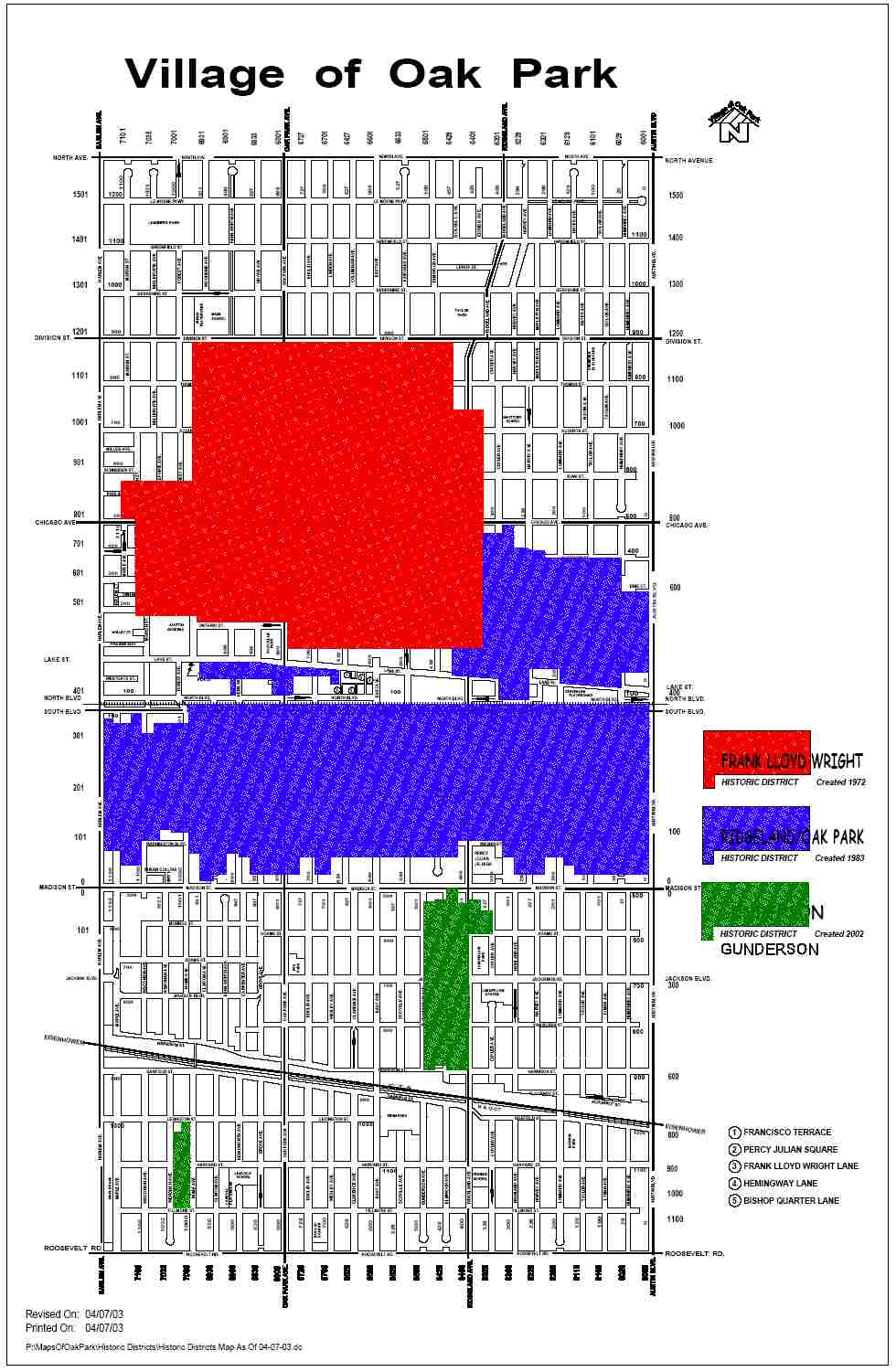
Park Historic District Map
Downtown
Oak Park Architectural Survey
Oak
Park Historic Preservation Commission
Universal Access
in Historic Buildings
National
Trust for Historic Preservtion
Illinois
Historic Preservation Agency
Landmarks
Illinois
Preservation
Chicago
Save the
Point (Promontory Point)
Commission on Chicago Landmarks
Chicago
Architecture Foundation
Henry Schlacks Society
Slide Show: Accessibility and Historic Preservation
OAK PARK HISTORIC PRESERVATION
COMMISSION
ARCHITECTURAL
REVIEW GUIDELINES
Note that these Guidelines
are mandatory for Oak Park Landmarks
and advisory for other buildings
located in Oak Park historic districts
Approved January 18, 1994
Modified March 15, 1999
A. Preamble
These Architectural Review
Guidelines are intended to be followed by Owners in remodeling existing
buildings, adding to existing buildings, or constructing new buildings
in the Village of Oak Park. They will be the principles by which
the Historic Preservation Commission will review submittals for proposed
work within the historic districts or work on Oak Park Landmarks.
The Guidelines are not meant to be exhaustive or all-encompassing.
They are expected to be used in the most general sense, considering that
every project is unique. Many options will be available to
the Owner in following the intention of the Guidelines. These Guidelines
are mandatory for all Oak Park Landmarks and are advisory for other buildings
located within the Oak Park historic districts.
The purpose for architectural
review is to protect the unique visual qualities of a building and its
site that define their sense of history from inappropriate proposed alterations
that will reduce that sense. The basic principles of review are to
determine that the following qualities of the building and site are compatible
with both the building in question and its neighborhood context:
1. Siting
2. Massing
3. Scale
4. Materials
5. Street rhythm
The Secretary
of the Interior's Standards for Rehabilitation and Guidelines for Rehabilitating
Historic Buildings published by the Department of the Interior
National Park Service, revised 1990, is the standard that the Historic
Preservation Commission will follow in the architectural review process,
and is appended by reference. This 59-page pamphlet is available
from the Village of Oak Park, the Illinois Historic Preservation Agency
in Springfield, Illinois, or the U.S. Government Printing Office in Washington,
D.C. 20402. It is also online at http://www2.cr.nps.gov/tps/tax/rhb/index.htm.
The ten standards included in this document are as follows:
1.
A property shall be used for its historic purpose or be placed in a new
use that requires minimal change to the defining characteristics of the
building and its site and environment.
2.
The historic character of a property shall be retained and preserved.
The removal of historic materials or alteration of features and spaces
that characterize a property shall be avoided.
3.
Each property shall be recognized as a physical record of its time, place,
and use. Changes that create a false sense of historical development,
such as adding conjectural features or architectural elements from other
buildings, shall not be undertaken.
4.
Most properties change over time; those changes that have acquired historic
significance in their own right shall be retained and preserved.
5.
Distinctive features, finishes, and construction techniques or examples
of craftsmanship that characterize a historic property shall be preserved.
6.
Deteriorated historic features shall be repaired rather than replaced.
Where the severity of deterioration requires replacement of a distinctive
feature, the new feature shall match the old in design, color, texture,
and other visual qualities, and, where possible, materials. Replacement
of missing features shall be substantiated by documentary, physical, or
pictorial evidence.
7.
Chemical or physical treatments, such as sandblasting, that cause damage
to historic materials shall not be used. The surface cleaning of
structures, if appropriate, shall be undertaken using the gentlest means
possible.
8.
Significant archaeological resources affected by a project shall be protected
and preserved. If such resources must be disturbed, mitigation measures
shall be undertaken.
9.
New additions, exterior alterations, or related new construction shall
not destroy historic materials that characterize the property. The
new work shall be differentiated from the old and shall be compatible with
the massing, size, scale, and architectural features to protect the historic
integrity of the property and its environment.
10.
New additions and adjacent or related new construction shall be undertaken
in such a manner that if removed in the future, the essential form and
integrity of the historic property and its environment would be unimpaired.
B. Establishing
Historic Contextual Character:
Prior to review of any project,
the Historic Preservation Commission will establish the historic character
of the property being reviewed and its context through study of the drawings
and visits to the site. To establish the inherent historic
character of the building, the historic district, or the immediate neighborhood
of the building in question, the Commission will determine the following:
-
Siting
-
Landscape style
-
Major tree locations
-
Building setbacks
-
Garage and automobile access
-
Driveways
-
Fencing
-
Massing
-
Building Height to Width ratio
-
Rhythm of facade opening spacing
-
Major divisions of street facade
into "bays"
-
Overall plan shape
-
Roof shapes
-
Roof slopes
-
Chimney location (center, ridge,
slope)
-
Roof overhangs
-
Ratio of solid to void in facade
(i.e., window openings to wall)
-
Height to width ratio of windows
-
Scale
-
Lot width to building width
-
Number of stories
-
Size of material textures
-
Materials
-
Roofing materials
-
Gutters and downspouts
-
Wall materials
-
Trim around windows and doors
-
Colors of roof, walls, and trim
-
Decorative cornices
-
Window types (double hung, casement,
leaded glass, Palladian)
-
Door types (flush, paneled,
glazed)
-
Porch types (partial, full,
wraparound, screened, enclosed, none)
-
Street rhythm
-
Historic styles in the area
-
Building massing of adjacent
buildings
-
Roof shapes of adjacent buildings
-
Roof slopes of adjacent buildings
C. Materials
that may be requested to be submitted by Owner to Historic Preservation
Commission for architectural review:
-
Site plan showing building,
proposed additions, and existing and proposed landscaping (minimum scale
1" = 20'-0")
-
Demolition plans (minimum scale
1/4" = 1'-0")
-
Proposed new construction plans
(minimum scale 1/4" = 1'-0")
-
Proposed new construction details
-
Masonry, tuckpointing, roofing,
siding, and window specifications
-
Color photographs (or color
photocopy of photograph) of all elevations
-
Photographs (or photocopy of
photograph) of all areas to be demolished
-
Work write-up, material specifications,
and cost estimate
In addition, the architectural
review team of the Historic Preservation Commission will make at least
one site visit.
D. Do
not do any work prior to the architectural review, and especially do not
do any of the following types of work due to their irreversible nature:
-
Do not do any demolition or
removal of historic materials
-
Do not remove windows
-
Do not sandblast or high-pressure
wash historic materials
-
Do not tuckpoint masonry
E. Definitions:
-
Decorative windows: Historic
windows that possess special architectural value, or contribute to the
building's historic, cultural, or aesthetic character. Decorative
windows are those with leaded glass, art glass, stained glass, beveled
glass, prismatic glass, Luxfer prisms, or specially shaped windows such
as lancet, round-arched, oriel, or Palladian windows.
-
Demolition: The razing
or destruction, whether entirely or in a significant part of a building,
structure or object. Demolition includes the removal of a building,
structure or object from its site or the removal or destruction of its
facade or surface.
-
Historic material (or object):
Material (or object) from which the building is built which is older than
50 years.
-
Maintain: To keep a building
and grounds in an acceptable state of good repair and function in accordance
with the requirements of the Oak Park Codes that apply to buildings.
-
Masonry: Brick, concrete
block, or natural stone
-
Period of significance:
The time period in which the building was first built or during which it
has derived its historic significance, as stated in the historic landmark
or historic district nomination.
-
Reversible: New construction
work that can be removed in the future without requiring demolition of
historic materials.
-
Repair: To maintain a
building or portion of a building in place using the same materials that
exist, or with very minimal addition of new materials. (note that this
definition is different from the definition of "Repair" in the Historic
Preservation Ordinance, because it is used in a different context herein.)
-
Synthetic siding or soffits:
Aluminum, vinyl, cement-asbestos shingles, thin pressed wood (masonite),
plywood sheeting, or similar materials which are used to imitate other
materials on buildings for siding or soffits, and which are non-historic.
Synthetic siding or soffits were normally used, but not always, to cover
original historic siding and soffit material.
-
Technically Infeasible:
Not possible to accomplish something due to substantial additional cost
in comparison to approved alternative methods that meet these guidelines.
-
Tuckpointing: Repointing
masonry by removing existing mortar from joints and filling with new mortar.
-
Visible from the Street:
Able to be seen by a person walking on the public street or sidewalks along
the street on which a building is located. In the case of a building
located on a corner lot, the street means both streets on which the building
is located. "Street" does not mean the alley behind the building.
-
For definitions of other commonly-used
terms, please refer to Steven J. Phillips, The Old House Dictionary, American
Source Books, Lakewood, Colorado, 1989.
F. Masonry
Repair Policy
-
Repair rather than replace masonry
materials unless it is technically infeasible to do so.
-
If replacement of masonry materials
is necessary, replacement materials shall be the same color, texture, and
type of material as that which is being replaced, unless it is technically
infeasible to do so.
-
Do not sandblast masonry.
-
Do not high-pressure water blast
masonry.
-
Tuckpointing shall be done following
National Park Service Preservation Brief Number 2 and Illinois Preservation
Brief Number 10.
-
Use cement-lime mortars appropriate
to the type of masonry to be tuckpointed.
-
Do not use premixed "masonry
cements" that contain no lime for tuckpointing.
-
Joint profiles and colors of
tuckpointing shall match existing historic tuckpointing.
-
Do not parge or apply stucco
to masonry surfaces that were not historically parged or stuccoed.
-
Do not install synthetic siding
over masonry materials.
G. Siding
and Soffit Policy
-
Repair rather than replace siding
and soffit materials unless it is technically infeasible to do so.
-
If replacement of siding and
soffit materials is necessary, replacement materials shall be the same
color, texture, and type of material as that which is being replaced, unless
it is technically infeasible to do so.
-
Do not sandblast siding and
soffits.
-
Do not high pressure water blast
siding and soffits.
-
Where synthetic siding or soffits
exist, it is recommended to remove it and repair the original historic
siding under it, unless it is technically infeasible to do so.
-
The Commission may approve new
synthetic siding or soffits subject to the following requirements:
-
Existing wood siding or soffits
are so deteriorated or damaged that they cannot be economically repaired.
-
The synthetic siding or soffit
material can be installed without removing, damaging, or obscuring character-defining
architectural features or trim.
-
The synthetic siding or soffit
material matches the historic material in size, profile, and texture.
-
For Certificate of Appropriateness
reviews, before review of proposed synthetic siding or soffit work, the
following material must be submitted to the Historic Preservation Commission:
-
Photographs showing evidence
and extent of deterioration of existing wood siding (or site visit by review
team).
-
Cost estimate with detailed
breakdown of both replacement and repair work, produced by proposed installation
contractor demonstrating that repair of existing siding is not economically
feasible.
-
Photographs showing all areas
to be covered by synthetic siding or soffits.
-
Samples of existing and proposed
synthetic siding.
-
Name and address of proposed
synthetic siding installation contractor, with list of successful applications
in the area.
-
No new trim or moldings may
be added to historic exterior surfaces unless it can be shown that such
trim would have been historically used for that type of building.
H. Window
Policy
-
Windows are significant character-defining
elements of historic buildings. Do not destroy the character of a
historic building by maintenance, repair or replacement of existing windows.
Therefore avoid the removal or alteration of windows wherever possible.
It is important to respect the stylistic intention of the historic architect
or builder when repairing or replacing historic windows.
-
Maintain and routinely repair
rather than rebuild, repair or replace existing windows. Maintenance
and routine repair of windows shall include:
-
Replacement of broken glass,
and/or associated muntins, moldings or glazing compound with material that
matches the original in shape, size and material
-
Scraping, priming and repainting
of window sash and/or frame
-
General upkeep such as caulking
around frames and sills, or replacing weatherstripping
-
Repair and replacement of window
hardware that matches the original in scale and design
-
Rebuild or repair portions
of existing window frames, sashes, sills, or portions thereof, rather than
replace complete windows unless it is technically infeasible to do so.
-
Repair procedures for wood windows
shall include the following:
-
Reinforcing, splicing, patching
or rebuilding portions of the window using the same material constructed
to the same configuration, size and shape as the original.
-
Filling or consolidating existing
wood members with cellulose type wood fillers or chemical materials such
as plastics
-
Repair procedures for steel
or metal windows shall include the following:
-
Replacing individual deteriorated
or rusted frame or mullion sections using the same metal to match size,
configuration and finish of original. Firmly attach new members to the
original so that it is not possible to detect replacement material from
the street.
-
Repair rather than replace
historic decorative windows as defined herein.
-
Replacement of historic windows
may be approved under the following conditions:
-
Historic windows are not decorative
windows as defined herein.
-
Repair of historic windows is
technically infeasible.
-
Appearance:
-
Match critical details such
as window size, shape, operation, glass configuration, material and finish.
-
The appearance of the window
sash, as well as opening size and decorative detailing shall look like
the existing historic window from the street.
-
Operation:
-
Replacement windows shall operate
in the same manner as the existing historic windows (for example, replace
existing double-hung windows with new double hung windows, replace existing
casement windows that open inward with new casement windows that open inward,
etc.)
-
Muntins:
-
Replacement window sash shall
have the same muntin ("lite" configuration) as the existing historic windows.
Insulating glass may be used in new windows.
-
The configuration of replacement
muntins shall have historic profiles and should form true divided lites
(i.e., individual panes of glass) if existing windows were divided into
individual panes.
-
Exterior applied muntins that
are permanently fixed to the exterior or both exterior and interior of
the glass may be approved as a substitute for true divided lites.
Submit sample of muntin and fixing detail to be used.
-
Do not propose interior snap-in
muntins to be used in place of true divided lite muntins. This type
of detail will be considered acceptable only under unusual visual circumstances
and where it is shown to be technically infeasible to provide either true
divided lites or exterior applied muntins.
-
Sash and frame materials
-
Wood windows should be replaced
in the same material but not necessarily in the same species of wood.
-
Wood windows may be replaced
with vinyl clad or aluminum clad wood windows with a finish that appears
to match the existing finish as visible from the street.
-
If the historic window being
replaced is a simple one-over-one sash with non ornamental frames the material
to be used for the replacement window may not have to replicate the original
materials. However, the sash and frame profiles and finish of the
replacement window shall appear the same as the historic window from the
street.
-
Metal windows shall be replaced
with new metal windows, but not necessarily the same metal. Sash
and frame profiles and finish of the replacement window shall appear the
same as the historic window from the street.
-
Replacement of non-original
windows that have replaced the original windows at some time in the past
-
Where new replacement windows
are proposed to replace non-original windows in a building, the design
and detail of the replacement window shall be based on the documented configuration
of the building's original windows. Such documentation may be obtained
from historic photographs, drawings, or the design of the new replacement
windows may be based on window configurations typical to the period of
significance of the building.
-
Where non-original windows are
historic themselves and contribute to the history or significance of the
building ("changes over time"), or are considered as having historic significance
themselves, the design of the new replacement windows may be based on the
existing non-original windows. Such cases will be determined on an
individual basis.
-
Multi Family dwelling master
plans:
-
A master plan shall be created
for the phased repair and/or replacement of windows in multi-family dwellings.
Such a master plan shall identify existing and proposed conditions, and
provide design standards for systematic future replacement work.
-
Replacement glass
-
Replacement glass may be insulating
glass.
-
Replacement glass shall be clear
if historic glass is clear.
-
Reuse historic rolled ("wavey")
glass from historic windows in new or replacement windows, unless it is
technically infeasible to do so.
-
Where historic tinted glass
will be replaced, match color of historic tinted glass.
-
Where historic reflective glass
will be replaced, match reflectance and color of historic reflective glass.
-
"Low-E" or other similar light-absorbing
or reflective coatings on glass will be permitted only if it can be demonstrated
that there will be no appearance change of glass color or reflective value
from the historic appearance of the glass where visible from the street.
-
Removal of historic leaded glass,
art glass, stained glass, bevelled glass, prismatic glass, or Luxfer prisms
shall not be permitted, unless it is irreparably damaged and repair is
technically infeasible.
-
Plexiglass, Lexan or similar
types of acrylic plastic glazing materials are not permitted to be used
for replacement historic glass, unless it can be documented that these
products were used in the historic building.
-
Glass block will not be permitted
as new or replacement windows unless it is characteristic of the style
of the building (e.g. Art Deco style). If historic glass block is
replaced, it shall be replaced with new glass block with similar shape,
color, reflectivity, and texture as the historic material.
-
Storm Windows and Screens
-
Historic existing storm and
screen windows shall be repaired and reused unless it is technically infeasible
to do so.
-
New or replacement storm and
screen windows shall match the original, or those characteristic of the
period or style of the building, unless it is technically infeasible to
do so.
-
New storm windows or screens
installed on windows where none existed in the past shall be installed
on the interior of the historic window unless it is technically infeasible
to do so.
-
Clear glass storm windows with
a minimum frame width may be installed as a protective measure for decorative
art glass windows. Provide sufficient ventilation to prevent condensation
between the historic window and the protective storm window.
-
New triple-track storm and screen
combination window may be added to any window if the following conditions
are met:
-
Existing storm and screen windows
are non-existent or are so deteriorated or damaged that they cannot be
economically repaired.
-
The new storm and screen windows
can be installed without removing, damaging, or obscuring character-defining
architectural features or trim, and will be installed in such a way
as to be able to be removed in the future without destroying architectural
features.
-
The new storm and screen windows
are as unobtrusive as possible and match the historic window major glass
division.
-
Window Shutters
-
New shutters on buildings may
be permitted only if it can be shown that shutters were installed or may
have been installed historically on the building.
-
Shutter design, type, size,
and material shall be characteristic of the significant period of the building.
I. Awning
Policy
-
Maintain and repair existing
historic awnings
-
New awnings may be permitted
if constructed in materials appropriate to the style of the building.
-
Electrically back-lit awnings
will not be permitted.
-
Complex awning shapes such as
bubbles on domes, or arches on quarter vaults will not be permitted.
-
Aluminum awnings will not be
permitted unless they are characteristic of the period of significance.
-
No new awnings will be permitted
unless it can be shown that historic features of the building will not
be damaged or destroyed in installing or removing awnings.
J. Exterior
Door Policy
-
Repair rather than replace doors
(entry, storm and screen) unless it is technically infeasible to do so.
-
If repair of historic doors
(entry, storm and screen) is technically infeasible, new replacement doors
may be approved if they duplicate the existing size, shape, proportion,
profiles, hardware, details, glazing, panel type and design, and operation.
-
Painted or stained wood, and
aluminum clad doors are acceptable replacements for historic wood doors.
-
Bronze or bronze-plated doors
are acceptable replacements for historic bronze doors.
-
Anodized aluminum or coated
aluminum doors are acceptable replacements for historic aluminum doors.
-
Painted steel or clad steel
doors are acceptable replacements for historic steel doors.
-
Profiles, sizes, and locations
of panels shall match panels on historic doors.
-
Repair rather than replace transom
windows and door casings, or replicate such if there is evidence of their
original configuration.
-
Repair rather than replace existing
historic hardware, unless it is technically infeasible to do so.
-
New hardware proposed to replace
historic hardware should be simple, unobtrusive, and compatible with the
style and period of significance of the building.
-
Replacement glass in doors
-
Replacement glass may be insulating
glass.
-
Replacement glass shall be clear
if historic glass is clear.
-
Where historic tinted glass
will be replaced, match color of historic tinted glass.
-
Where historic reflective glass
will be replaced, match reflectance and color of historic reflective glass.
-
"Low-E" or other similar light-absorbing
or reflective coatings on glass will be permitted only if it can be demonstrated
that there will be no appearance change of glass color or reflective value
from the historic appearance of the glass where visible from the street.
-
Removal of historic leaded glass,
art glass, stained glass, bevelled glass, prismatic glass, or Luxfer prisms
shall not be permitted, unless it is damaged and is technically infeasible
to repair it.
-
Plexiglass, Lexan or similar
types of acrylic plastic glazing materials are not permitted to be used
for replacement historic glass, unless it can be documented that these
products were used in the historic building.
-
Glazing muntins:
-
Replacement doors shall have
the same muntin ("lite" configuration) as the existing historic doors.
-
The configuration of replacement
muntins shall have historic profiles and should form true divided lites
(i.e., individual panes of glass)
-
Snap-in muntins shall not be
permitted
-
Applied muntins which are permanently
fixed to the glass may be approved. Submit sample of muntin and fixing
detail to be used.
-
Elimination of the original
or historic door opening, or creation of new door openings is not acceptable
on surfaces visible from the street.
-
Garage doors visible from the
street:
-
Repair rather than replace original
or historic garage doors are significant to the character of the garage,
unless technically infeasible to do so.
-
If repair of historic garage
doors is technically infeasible, new replacement garage doors may be approved
if they duplicate the existing size, shape, proportion, profiles, hardware,
details, glazing, panel type and design, and operation, and fit within
the existing opening.
K. Mechanical
Units
-
Window air conditioners:
These will be permitted where it can be shown that no historic features
will be removed in either installing or removing window air conditioners.
-
Through-wall mechanical units
will not be permitted on surfaces of the building visible from the street.
L. Porch
Policy
-
Historic porches visible from
the street shall be maintained and repaired.
-
If existing historic porches
have deteriorated or become badly damaged they may be replaced in the same
size and shape with appropriate new materials. Retain as much of
the existing porch materials unless it is technically infeasible to do
so.
-
If historic porches which
have been enclosed in the past are proposed to be remodeled or altered,
they shall be restored to their appearance during the period of significance,
unless the enclosure, by nature of its age, architectural significance,
or other special circumstance, has achieved historic significance of its
own.
-
Proposed new porches shall be
similar to historic porches which have been removed with regard to size,
style and detail, to the extent that such historic porch can be documented.
Where inadequate documentation exists for original porch, proposed
new porches shall be typical of those built in the style of the historic
building.
-
Porches may be enclosed, as
long as the construction of the enclosing elements are readily reversible,
and as long as no character-defining features are damaged or obscured by
the enclosure. Removable, wood framed seasonal storm windows or screens
are recommended over more permanent and scale-changing triple-track storms
and screens or jalousie windows for porch enclosures.
-
Proposed new railings and balusters
on existing and new porches shall use materials and shall be designed in
style similar in appearance to historic balusters and railings characteristic
of the style of the historic building.
-
New and existing wood which
is visible from the street shall be painted unless it can be documented
that the original wood was unpainted or stained (unpainted pressure treated
wood will not be permitted).
-
Porch floors shall be of a type
characteristic of the style of the historic building. Spaced planks
shall not be used where painted tongue-and-groove boards would have been
used historically.
-
Concrete steps and porches will
be permitted if it can be shown that they existed on the building historically
or if they are characteristic of the style of building (e.g. Art Deco)
-
Decks:
-
New decks will be permitted
if they are not visible from the street
-
New decks which are visible
from the street will be permitted if it can be shown that they are characteristic
of the style of the historic building, or if they can be enclosed in partial
height walls or balustrades which would be characteristic of the style
of the historic building.
M. Roofing
Policy
-
Repair rather than replace roofing
materials unless it is technically infeasible to do so.
-
If replacement of roofing materials
is necessary, replacement materials shall be the same color, texture, and
type of material as that which is being replaced, or the original historic
roofing materials, unless it is technically infeasible to do so.
-
If historic roofing has been
removed or covered in the past, and replacement of existing roofing is
proposed, selection of material for reroofing shall be similar with
regard to size, style, and details of original historic roofing materials
to the extent that such original roofing can be documented. If no
photographic or other documentation exists for original historic roofing
materials, selection of new materials shall be typical of those used in
the style of the historic building.
-
Reroofing projects may be approved
subject to the following requirements:
-
Existing roofing materials are
so deteriorated or damaged that they cannot be economically repaired.
-
Proposed new roofing material
can be installed without removing, damaging, or obscuring character-defining
architectural features or trim.
-
Proposed new roofing material
matches as closely as possible the existing or historic roofing material
in size, profile, and texture.
-
The original form and shape
of the roof shall be retained
-
Character defining features
of the roof shall be retained (cupolas, weather-vanes, dormers, cornices,
brackets, chimneys, cresting, and finials)
-
Flat roofs which are not visible
from the street may be replaced with any new material.
-
For Certificate of Appropriateness
reviews, prior to review of proposed reroofing work, the following material
must be submitted to the Historic Preservation Commission:
-
Photographs showing evidence
of deterioration of existing roofing materials.
-
Cost estimate with detailed
breakdown of new and repair work, produced by proposed roofing contractor
demonstrating that repair of existing roofing is not economically feasible.
-
Photographs showing all areas
to be covered by reroofing.
-
Samples of existing and proposed
roofing materials.
-
Name and address of proposed
roofing contractor, with list of successful applications in the area.
-
Changes to the roof slope are
not acceptable, unless earlier, non-historic changes are being reversed.
-
Historic or existing roofing
materials shall be maintained and repaired in place, or replaced with the
following approved substitute roofing materials, retaining the same size,
shape, and texture as the existing materials.
-
Existing or Historic Material
Acceptable New Replacement Material (in order or recommended preference):
-
Slate
-
Slate
-
Cement/mineral fiber shingles
-
Asphalt shingles of similar
size, shapes, and colors
-
Clay Tile
-
Clay Tile
-
Cement Tile
-
Metal shingles of similar size,
shapes, and colors
-
Asphalt shingles of similar
size, shapes, and colors
-
Cement Tile
-
Cement Tile
-
Clay Tile
-
Metal shingles of similar shapes
-
Asphalt shingles of similar
size, shapes, and colors
-
Copper -- standing seam
-
Copper -- standing seam (chemical
accelerated patination shall not be permitted)
-
Aluminum -- standing seam with
green coating to imitate copper patina
-
Galvanized steel -- standing
seam with green coating to imitate copper patina
-
Terne metal -- standing seam,
painted with green paint to imitate copper patina
-
Note: In all cases, seam
spacing and configuration of seams shall be similar to existing or
historic roof.
-
Metal roofing -- other than
copper
-
Metal of same type and configuration
as that which is being replaced
-
Terne-coated stainless steel
-
Lead coated copper
-
Aluminum with same configuration
as existing and coating to match color of existing roofing
-
Galvanized steel roofing with
same configuration as existing and coating to match color of existing
roofing
-
Cement-asbestos shingles
-
Cement-Mineral fiber shingles
of similar size, shapes and colors
-
Asphalt shingles of similar
size, shapes and colors
-
Wood shingles
-
Wood shingles -- stained to
match color of existing shingles (do not use hand-split and resawn
wood "shakes")
-
Asphalt shingles of similar
size, shapes and colors (do not use "wood shake" or heavily textured
asphalt shingles)
-
Asphalt shingles
-
Asphalt shingles of similar
size, shapes and colors
-
Do not install a roofing material
which is characteristic of a different period of significance, e.g. a Mission
type clay tile roof on an Art Deco building.
-
New roof valley materials shall
be the same as existing historic valleys, and shall be detailed to
look the same.
-
Gutters and downspouts:
-
Maintain and repair existing
gutters and downspouts in place. If existing gutters and downspouts
are deteriorated to the extent that they must be replaced, new gutters
and downspouts shall match the original historic gutters and downspouts
if such is known, or shall be of size and profile that would be characteristic
of the period of significance.
-
Note that galvanized half-round
sheet metal gutters may in many cases be more appropriate for most historic
buildings which had exposed gutters than the colonial profile aluminum
gutters and downspouts commonly used today.
-
Where built-in gutters exist
and must be repaired, repair or replace only those sections which require
it, using similar materials to existing historic built-in gutters.
-
Cupolas, finials, cresting,
and other roof ornament: Where these objects exist, repair and maintain
in place. Where these do not exist, do not install new ornament unless
it can be shown that it historically existed on the roof of that particular
building.
-
Skylights or roof windows may
be installed only on surfaces which are not visible from the street.
-
New fireplace or chimney flues
shall be located on surfaces which are not visible from the street and
shall be constructed either of masonry materials to match other chimneys
on the building or shall be metal painted to match the color of roof.
-
Roof vents or attic fans:
-
Unless documentation exists
that shows that were present on visible portions of the historic
roof, new roof vents and attic fans should be located on surfaces which
are not visible from the street.
-
They shall be as unobtrusive
as possible and shall be painted to match color of roof.
-
Toilet vent stacks shall be
flashed with lead or shall be painted to match color of roof.
-
Solar panels, satelitte dishes,
and ham radio antennas:
-
These types of objects will
be permitted only on surfaces which are not visible from the street.
-
If location is required to be
in an area which is visible from the street, submit drawing showing proposed
location along with rationale as to why the object must be located in visible
area. If approved in such locations, use one or more of the following
techniques to reduce visual impact of objects which are out of character
with the historic district:
-
Do not attatch such objects
to historic materials, or, if that is not possible, attatch to historic
materials using the least intrusive methods. Submittal of method
of attatchment will be required by the Commission to assist in determination
of acceptability for location of such objects in an area which is visible
from the street.
-
Provide berms or other types
of enclosures to hide such objects from street view.
-
Paint objects with a color to
blend with historic materials to which the object is attached.
-
Do not damage existing building
materials during installation of these objects, and assure that when the
object is removed in the future, the removal process will not be likely
to damage such materials
-
Dormers: See "New Addition
Policy" section below.
N. Paint
Policy
-
Paint color selection is not
regulated by the historic preservation ordinance.
-
Do not paint masonry, concrete
or stucco which has never been painted
-
Do not paint historic roofing
materials unless they were originally painted or intended to be painted
(such as galvanized sheet metal or terne metal)
-
Use only breathable paints (such
as latex or acrylic latex paints) on stucco or masonry which has historically
been painted, to allow vapor to escape.
-
Do not use sandblasting, or
high pressure water blasting to remove paint from masonry or wood surfaces
(it is acceptable to use these methods for paint removal from cast iron
or steel surfaces)
-
Do not use transparent or opaque
stains on surfaces which have been historically painted.
-
Do not paint wood which has
historically been stained
-
Prior to repainting, remove
only loose paint from surfaces that have been historically painted.
Complete removal of all paint from a surface is not necessary prior to
repainting. Where bare wood is exposed in preparation process, prime
wood before painting finished coats. The use of open flame
or propane torches to remove paint from siding is not allowed.
O. New
Addition Policy
-
New additions in historic districts
must be compatible with the size, scale, set-back, massing, material, and
character of the building to which it is attached.
-
New additions shall not remove
significant character-defining features or historic material visible from
the street.
-
To minimize impact of an addition
on the historic building, additions shall be constructed on a secondary
or tertiary facade.
-
New additions shall not change
the historic character of the building.
-
New additions shall protect
the historic significance of the building by making a visual distinction
between old and new.
-
Dormers: Limit size of
new dormers to 1/2 of roof area visible from the street. Dormer roof
design shall match the slope of main roof and shall be constructed in the
same materials. Dormer windows shall be similar to that of main house.
-
Floor additions: If an
entire new floor or floors are added to a building, the overall bulk of
the building as viewed from the street shall not be more than 1/3 larger
than that of adjacent buildings. Exterior materials of new floors
shall be constructed in the same materials as the existing historic building,
or in combinations of materials which may have been historically used within
the style.
-
Turrets, oriels, bays, sun-spaces,
greenhouses, and cupolas: These types of additions will be permitted
only on surfaces which are not visible from the street, or on surfaces
which are visible from the street if they were characteristic of the style
of the house. Shape, size, and details of visible additions of this
type shall be typical of the style of the house.
-
New flagpoles or flag brackets
will be permitted in any location
-
New mailboxes or house numbers
will be permitted in any location
P. New
Building Policy
-
A new building in a historic
district must be compatible with the size, scale, set-back, massing, material,
and character of the buildings which surround it on the same and
adjacent blocks (the zone of influence for new buildings is six blocks
-- the block on which the building is proposed to be built, the two adjacent
blocks on the same side of the street, and the three opposing blocks on
the other side of the same street).
-
A new building shall not change
the historic character of the other buildings which surround it on the
same and adjacent blocks.
-
A new building shall have its
front entrance facing the same direction as the majority of buildings on
the same block, unless it can be shown that compatibility with adjacent
buildings can be achieved better through a different orientation.
-
A new building built in a historic
district shall be compatible but visually distinct from other buildings
which surround it on the same and adjacent blocks.
Q. Garage
Policy
-
Maintain and repair historic
garages visible from the street. They may be altered to accommodate
contemporary vehicles.
-
New carports will be permitted
only if it can be shown that carports are characteristic of the historic
style of the principal building on the lot.
-
New garages or carports must
be compatible in style, size, material, roof profile, and details with
the historic principle building on the lot.
-
New garages and carports shall
be accessed from the alley where alleys exist at the rear of any house.
-
Where driveways and curb-cuts
exist, do not widen.
R. Sign
Policy
-
Historic signs shall be maintained
and repaired unless it is technically infeasible to do so.
-
New signs shall be compatible
with style of building.
S. Exterior
Lighting Policy
-
New light fixtures may be added
for lighting entrances or yards if the fixtures are compatible with the
historic style of the building.
-
High intensity discharge type
light fixtures such as mercury vapor, high pressure sodium, low pressure
sodium, or metal halide fixtures shall not be permitted to be mounted in
locations where fixture glare will be visible from the street.
-
High- or Low-pressure sodium
lights are not permitted for major illumination of facades visible from
the street unless their color is attenuated by combination with metal halide
fixtures.
T. Site
Features
-
Historic landscaping shall be
maintained.
-
Fences:
-
Historic fencing shall be maintained
and repaired
-
New fencing shall be either
similar to historic fencing used at the site, or shall be characteristic
of the period of significance.
-
Metal or plastic slats shall
not be used in chain link fencing visible from the street.
-
"Stockade" type wood fences
are not permitted for fences visible from the street. Where Zoning
Ordinance permits, solid wood fencing or walls which are visible from a
street may be approved if they are designed in character with the historic
building.
-
Conjectural site elements:
Proposed site elements, such as "Victorian" type street or yard lighting,
ornate benches, gazebos, or the like will not be permitted in areas visible
from the street, unless historic documentation shows that they existed
on the site, or unless they are characteristic of the period of significance.
-
Sidewalks:
-
If sidewalks are replaced, they
should be replaced in materials similar to those used in historic sidewalks
of the period of significance of the building.
-
If historic concrete sidewalks
are replaced, they shall be replaced with new concrete using "torpedo"
sand with smooth aggregates. Surface of sidewalk shall be weathered
by hosing and brushing with stiff broom to expose the aggregate prior to
concrete fully setting.
-
If Village-owned historic slate
sidewalk exists in front of building, it shall not be replaced, unless,
in the opinion of the Village, it has been irreparably damaged. If
existing historic slate sidewalks are replaced, they shall be replaced
with new slate of like thickness, color, and size.
-
If historic slate sidewalk is
damaged by owner or Owner's contractor during remodeling activities, cost
of replacing historic slate sidewalk shall be borne by person responsible
for breakage.
-
Excavations for basement light
and ventilation shall be permitted only on surfaces which are not visible
from the street.
U. Special
Accessibility Considerations
-
Where provisions for accessibility
for disabled persons are proposed to be added to a portion of a historic
building visible from the street, every effort shall be made to integrate
the accessibility provision with the historic design of the building.
-
Reversable and readily removable
accessibility provisions, such as ramps or chair lifts, should be provided
to prevent permanent damage to the historic fabric of the building.
Bibliography
_______. Books on
Frank Lloyd Wright. Oak Park (The Frank Lloyd Wright Home and
Studio Foundation), 1992.
_______. Frank Lloyd
Wright Heritage Trail. Oak Park, Thatcher Woods Area Council,
1993
Cummings, Kathleen Roy.
Architectural
Records in Chicago. Chicago, 1981
Brooks, H. Allen. The
Prairie School. New York, 1972.
Brooks, H. Allen, ed.
Prairie
School Architecture -- Studies from "The Western Architect."
New York, 1983.
Fields, Jeanette S., ed.
A Guidebook to the Architecture of River Forest. Chicago,
1981.
Fleming, John, Hugh Honour,
Nicholas Pevsner. The Penguin Dictionary of Architecture.
Guarino, Jean. Oak
Park -- A Pictorial History. St. Louis, 1988.
Harris, Cyril. Dictionary
of Architecture and Construction. New York: McGraw-Hill,
1975.
Hasbrouck, Wilbert R., AIA,
and Paul E. Sprague, Phd. The Hasbrouck-Sprague of Historic Architcture
in Oak Park. Oak Park, 1974.
McAlester, Virginia and Lee.
A Field Guide to American Houses. New York: Alfred
A. Knopf, 1984.
Moss, Roger. Century
of Color. New York, 1981
Moss, Roger, and Gail Caskey
Winkler. Victorian Exterior Decoration. New York, 1987
Phillips, Steven J.
The
Old House Dictionary: An Illustrated Guide to American Domestic Architecture
1600 to 1940. Lakewood, Colorado: American Source Books,
1989.
Poppeliers, John and S. Allen
Chambers. What Style is It? Washington, D.C.:
Preservation Press, 1983.
Radford, William A.
Old
House Measured and Scaled Detail Drawings for Builders and Carpenters.
New York (Dover), 1983.
Sanderson, Arlene, et al.
Ridgeland Revealed: Guide to Architecture of the Ridgeland-Oak
Park Historic District. Oak Park, 1993.
Shoppell, R. W., et. al.
Turn-of-the-Century Houses, Cottages and Villas. New York
(Dover), 1983.
Sprague, Paul E. Guide
to Frank Lloyd Wright and Prairie School Architecture in Oak Park.
Oak Park, 1976.
Steiner, Frances H.
Frank
Lloyd Wright in Oak Park and River Forest. Chicago, 1983.
Steiner, Frances H.
Victorian
Oak Park. Chicago, 1983.
Stickley, Gustav. Craftsman
Bungalows. New York (Dover), 1988.
Stickley, Gustav. Craftsman
Homes. New York (Dover), 1979.
Stickley, Gustav. More
Craftsman Homes. New York (Dover), 1982.
von Holst, Hermann Valentin.
Country and Suburban Homes of the Prairie School Period.
New York (Dover), 1982.
Whiffen, Marcus. American
Architecture Since 1780: A Guide to Architectural Styles.
Cambridge: MIT Press, 1992.
End
of Oak Park Historic Preservation Commission Architectural Review Guidelines