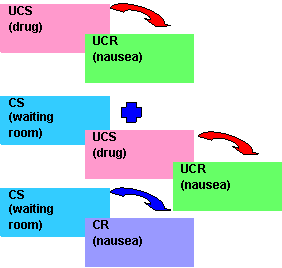
MODULE 20 - Classical Conditioning
§Ivan Pavlov
§1849-1936
§Russian physician/ neurophysiologist
§Nobel Prize in 1904
§studied digestive secretions
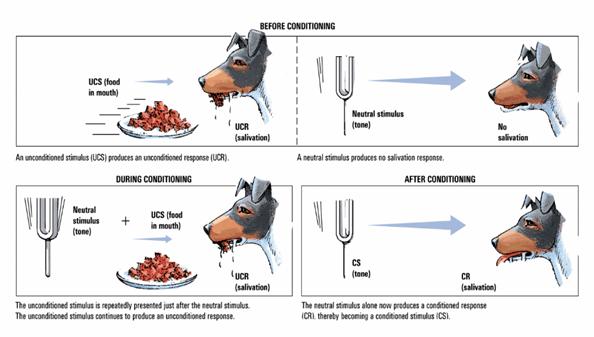
Pavlov’s Classic Experiment: Dogs and salivation (figure 20.2)
- Classical Conditioning
- organism comes to associate two stimuli
- a neutral stimulus that signals an unconditioned stimulus begins to produce a response that anticipates and prepares for the unconditioned stimulus
Classical Conditioning
- Unconditioned Stimulus
(UCS)
- stimulus that unconditionally--automatically and naturally--triggers a response
- Unconditioned Response
(UCR)
- unlearned, naturally
occurring response to the unconditioned stimulus
- salivation when food is in the mouth
- unlearned, naturally
occurring response to the unconditioned stimulus
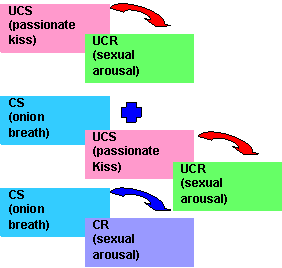
- Conditioned Stimulus
(CS)
- originally irrelevant stimulus that, after association with an unconditioned stimulus, comes to trigger a conditioned response
- Conditioned Response
(CR)
- learned response to a previously neutral conditioned stimulus
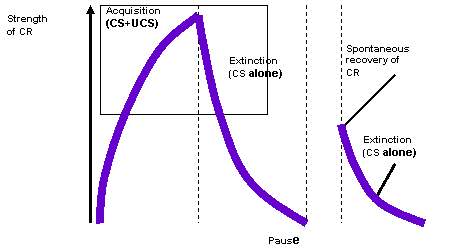
Acquisition
- the initial stage in classical conditioning
- the phase associating a neutral stimulus with an unconditioned stimulus so that the neutral stimulus comes to elicit a conditioned response
- in operant
conditioning, the strengthening of a reinforced response
Extinction
- diminishing of a CR
- in classical conditioning, when a UCS does not follow a CS
- in operant conditioning, when a response is no longer reinforced
Spontaneous Recovery
- reappearance, after a rest period, of an extinguished CR
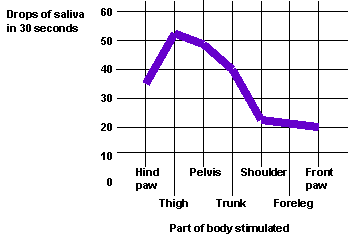
Generalization
- tendency for stimuli similar to CS to elicit similar responses
- See figure 20.5
Discrimination
- in classical conditioning, the learned ability to distinguish between a CS and other stimuli that do not signal a UCS